Friday, 24 August 2018

Polish inventions

Maria Salomea Skłodowska and Mikołaj Kopernik, two big names in Poland's history. Across the globe they are known as Marie Curie (physicist/chemist) and Nicolaus Copernicus (mathematician/ astronomer). These extremely talented and intelligent persons did amazing discoveries and made revolutionary inventions.

However, less known to the general public, there are more inventions done by Poles. Inventions which were truly spectacular at that time.

Józef Stanisław Kosacki (born in Warsaw) invented the portable mine detector

Kazimierz Żegleń (born in Tarnopol) invented the bulletproof vest.

Henryk Magnuski (born in Warsaw)
invented the walkie-talkie.

Kazimierz Prószyński (born in Warsaw) invented the film projector. He also invented the first stabilization camera. By the way, the story goes that he tested his invention while riding a horse.

Warsaw
Nice to know that so many of these bright minds came from Warsaw. Another man from Warsaw, Leo Gerstenzang, invented "Baby Gays".

Say what?!


Baby gays, the original name of cotton swabs. Or Q-tips, how they are called in the US and Canada after Unilever trademarked it. Those things which clog up your ear canals when you are so tempted to use them after having a minor ear wax blockage.


Mr Gerstenzang watched his wife attach wads of cotton to toothpicks, which inspired him before we emigrated to the US. There the product became a massive success. Q-tips, which stands for "quality tips". 

The Q-tips brand of Unilever has over $200 million of sales in the US alone! Although doctors have said for years that it is not safe to use cotton swabs for ear cleaning, it remains the most common use.

You clearly do not need to be a mastermind to invent things like this, but surely it was a massive success on the market!

So if you end up with a nasty ear infection after using a cotton swab, blame the guy from Warsaw! Or yourself :-)

Wednesday, 15 August 2018

Pablo Picasso

Picasso and Warsaw, I have seen several signs of a connection between the two, so I did some research on the link between them.

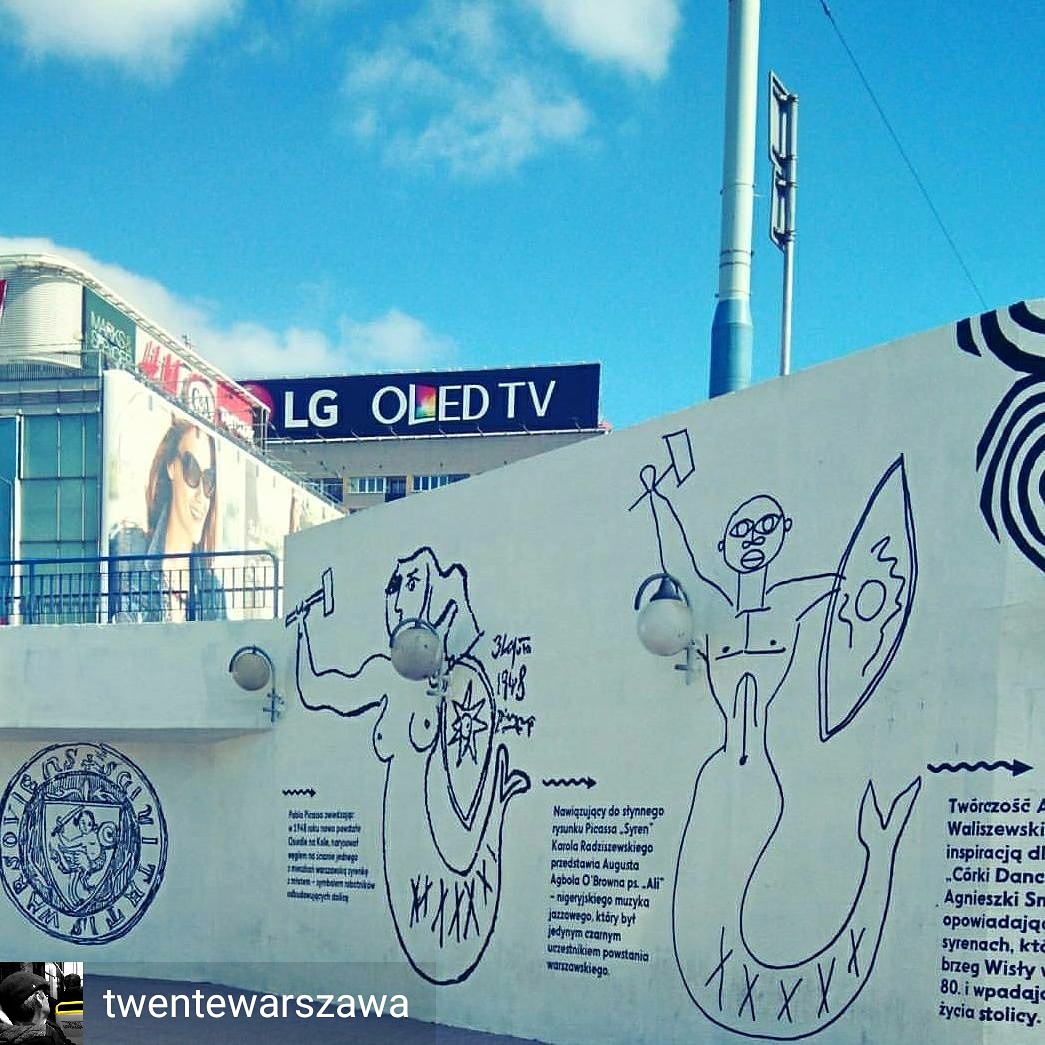
But before starting, I want to show you some of the street art which I photographed last year at the central metro station, or "Patelnia" (Pan) like they call it here. It shows a replica of drawings made by him, the symbol of Warsaw (a siren, mermaid).


In 1948, Pablo Picasso, a famous painter, was a member on the French communist party. As such, he was invited to Poland to some communist congress. He saw the rebuilding of Warsaw and was fascinated with it. He drew a picture of Warsaw Mermaid holding a hammer instead of a sword in one of newly constructed apartments. The tennants who lived there couldn`t bear the invasion of guests coming to see the drawing every day, so after a few years they washed the Mermaid from the wall.
 
It was just offensive to them that their "syrenka" was being shown as such. Like with many world famous artists, their art would only get popular later in their career or even after their death.
This was the particular drawing:


The tennant's story:

FRANCISZKA S., pensioner

...They took him (Picasso) to the still unfinished building. He liked it and went inside, asked for a ladder and took a black pencil from his pocket. He drew a mermaid . On the wall. Everyone was very happy and thanked him. And then they went away, and the mermaid stayed.

They assigned the flat to a railway worker. He looked around, and said that firstly it was inadequate and secondly he had small children, and she had bare breasts. So he didn’t take it, and they called me. I didn’t have any children or any points – the only thing I could have scored on was my activity in the food cooperative, but I wasn’t even a member of it, so when they said there was a flat, I rushed over there.

The building how it looks nowadays

They told me to sit down. You see – the director said – this isn’t an ordinary apartment, it’s one with a mermaid. Fine, I said. And you see, this apartment must be kept clean, because visitors might come by. I’ll keep it clean, I promised; got the keys, opened the door…


My dear madam, what can I say? It was a Picasso.
It was huge, my God was it huge. Her bosom was like two balloons, the eyes were triangular, at the end of her long, oddly long arm she held a hammer; and she had a short, tapering tail at the back.
We only had a sofa bed and a table. The table stood in the middle of the room and the sofa bed against the wall, with the hammer hanging over our heads. When we woke up, we saw her eyes, even more odd than her arm and the tail.

A group from China was the first to arrive. They were visiting Polish workers’ housing estates. After the Chinese came the miners, festive in their plumed hats. Then came the textile workers, they were labour heroes. I was polite – I knew I was representing our capital city – but inside I seethed. Especially when I looked at their boots and calculated how much muck I would have to take out that day.

The parliamentary speaker came to see us – tell me, comrades, aren’t you afraid to be with her, alone as it were? – he asked in the hallway. The president came and looked, but didn’t say a word. The gentlemen from the ministry came, took measurements and exchanged opinions. Maybe we could take it off together with the plaster? Aw, come on, it’s too delicate. Put it behind glass? Aw, come on, the frame wouldn’t hold up…

They got on our nerves. We hired a painter. The painter brought a bucket and soap.
It was only when he died and they started talking about the quarrels between his children that we thought: perhaps it wasn’t such a good idea…? We were motivated by public interest, for the mermaid was state owned, and we would have got nothing out of it. Like our tattered couch, for which were weren’t given a single cent in compensation.

The people from the ministry came again. They brought machines with them and x-rayed the wall. Gentlemen, don’t trouble yourselves, I said. It was a good, pre-war workman and good, ordinary soap.


Picasso stayed in the famous Bristol Hotel in Warsaw ('Varsovie'), if you look good you can see 'Bristol' written on the plate showing above. I took this photo in Muzeum Warszawy, but there was not mentioned much about his stay. If I can find more information about this I will definitely post it, because Picasso was not an ordinary man, I bet there are more adventures of him in the city.

Take care folks!

Street lanterns in Warsaw can save lives

In Warsaw there are over 100,000 lighting poles. On each of them there is a number that describes our location more accurately than providing an address or a characteristic point nearby. It is very valuable to the emergency services, because it allows a very precise location where they will need to come.

Below you can see a photo I took on Marszałkowsta street, lantern number 136.


If someone calls the emergency line 112 or the police and has difficulty determining which is the place, the phone operator can always ask callers to go to the nearest lantern to confirm its number.
These codes are visible on the maps which the emergency services use.
The head of the Warsaw security office stated the below:
This simple yet practical idea has not been implemented in any other European city. So Warsaw has something to boast about. The solution is particularly useful on the periphery of the city, where buildings are not always visible.
 
I have done some investigation and found out that a similar system is being used in Prague, Czech Republic. But anyway, I like this old school system which is a great help to the emergency services.


Tuesday, 17 July 2018

1st of August: Godzina W (Hour W)

There is a city...


August 1, 1944. The day the Warsaw Uprising went off. Backed up with just 3 days of armor and ammunition supply, civilians stood up for 63 days. The number of victims reached up to 180 thousand, with 16 thousand deaths among the insurgents. Approximately 85% of the city communications, infrastructure and houses were bombed to the ground. Every year on this day Warsaw symbolically stands motionless for a minute, to pay homage to the heroes who sacrificed their lives in the name of freedom. 
 
'Godzina W' means 'Hour W', code used for 17:00h in action 'Burza' (storm): the Warsaw Uprising.
 
My wife showed me the above video some years ago and I remember I got goosebumps watching it. One of the things I really wanted to do is to be there, in the center, amongst all those people. Feel it.
And so we did (put sound on):


I am really sensitive for these kinds of things, I will never forget the feeling.
Some people made a lot of footage that day at more locations, which you can see below,
really impressive.

 
Cześć i chwała Bohaterom! - Thanks and glory to the heroes!

Canaletto

Bernardo Bellotto, alias 'Canaletto', an Italian who played a big part in reconstruction of Warsaw after WW2. He died in here in Warsaw in the year 1780. 

Wait a second...read that sentence again. 
How in the world can a person who died play a part in reconstruction of the city after the 2nd world war?  

And who was this 'Canaletto'? It was Bernardo Francesco Paolo Ernesto Bellotto, a painter. I have seen several of his paintings and was amazed by the level of detail in them.

Photograph: Andrzej Ring, Lech Sandzewicz

August 1944 
It is August 1944 and the Polish resistance are in violent clashes with the Nazi forces that have occupied Warsaw. The resistance intend to liberate the city from what the Polish poet Czesław Miłosz has called the “dark, black and red world of Nazi occupation”.  

During the Warsaw Uprising, the ill-equipped Polish resistance succeed in inflicting serious damage on their oppressors, with 20,000 Nazi troops left wounded or dead. But it is the civilian population that suffers the greatest losses, with 150,000 people killed in air strikes and in fighting across the city.  
In retaliation, the Nazis raze the Polish capital to the ground. More than 85% of the city’s historic centre is reduced to ruins. Unlike in other European cities, where damage largely occurs during the fighting, Warsaw is systematically destroyed once the two months of conflict have ended, as an act of revenge by Hitler’s forces.

What follows is the story of how Varsovians (residents of Warsaw) reconstructed their city – in part from the cityscapes, or vedute, of the Venetian painter Bernardo Bellotto (1722-1780), often referred to as Canaletto after his more renowned uncle.

Bellotto, who was made court painter to the King of Poland in 1768, created beautiful and accurate paintings of Warsaw’s buildings and squares. It is testimony to the veracity of his work that almost 200 years later, those paintings were used to help transform the historic city centre from wreckage and rubble into what is now a Unesco World Heritage Site.

In the summer of 1947, the architect Hermann H Field led a small group of American designers to study the post-war reconstruction of Europe. They visited England, Czechoslovakia and Poland, where they surveyed Warsaw, Kraków, Katowice, Wrocław and Szczecin. Their photographs capture what has become a topos of post-war urban ruination: the exposed innards of buildings.  
Archive footage from British Pathé shows the buildings in 1950 appearing to fall arbitrarily. Across much of the city, only basements, low walls and the occasional ground floor section of a building remain. The grass lined alleys bring to mind the ruins of Pompeii.


The Varsovians who had not escaped Warsaw lived among the devastation, and would often find corpses buried in the rubble. Early on it was suggested that the remains of the city should be left to memorialise the war, and the entire capital be relocated.   
Clouds of dust asphyxiated Warsaw’s inhabitants. According to the Polish writer Leopold Tyrmand: “One of the philosophers calculated that Varsovians inhaled four bricks each year at that time. One must love one’s city in order to rebuild it at the cost of one’s own breathing. It is perhaps for this reason that, from the battlefield of rubble and ruins, Warsaw became once more the old Warsaw, eternal Warsaw ... Varsovians brought it to life, filling its brick body with their own, hot breath.” From the start of the rebuild, the city’s own rubble was utilised in the reconstruction process, and original fragments of Old Town buildings were recovered.

Rubble from the former ghetto district was used to produce new bricks for the modern quarter, while architectural details from demolished buildings in the Old Town were put on to the reconstructed facades,” explains Małgorzata Popiołek, an expert in heritage conservation at the Technical University of Berlin.  
While much of this work was done by construction workers and specialised builders, Małgorzata says local people were required to help clear the vast amounts of debris. “The entire nation builds its capital” became the city’s rallying cry.

When the rubble that was to hand would not suffice, more material was imported from neighbouring ruined cities. And to ensure it was all put back in roughly the right place, Bellotto’s cityscapes were used as references for key locations.  
Throughout history, the artist’s 22 street scenes have been hotly contested, and removed from Warsaw’s Royal Castle on numerous occasions. Napoleon’s officials took four canvases in 1807; Emperor Nicholas I of Russia seized the whole series in 1832; German authorities did the same in 1939.  

By this time, Bellotto’s paintings were especially prized because so many of the works documenting Poland’s history had been blacklisted by the Nazis. (Their blacklist consisted of artworks they believed had to be destroyed in order to implement the “Germanisation” of Poland.)

Andrzej Ring, Lech Sandzewicz
When Warsaw was bombarded in September 1939, the Burlington Magazine for Connoisseurs wrote of its concern for the safety of Bellotto’s paintings – but in fact, all 22 street scenes survived the war. Since 1984 they have been exhibited in the Royal Castle’s Canaletto room.  
Bellotto’s paintings, along with the expertise of Polish architects, art historians and conservators, enabled the reconstruction of the Old Town to take place in an impressively short period of time. Most of the work was finished before 1955 – although additional construction continued into the 1980s, and the city is arguably still feeling the impacts of the second world war even now.
   
The contemporary city is not, however, an entirely accurate recreation of Bellotto’s images. For one, Bellotto used a camera obscura to trace pencil drawings of the architecture, which were then transferred on to the canvas and finished off with watercolours. The use of that optical device has led to some minor inaccuracies.  

Warsaw now. The city places several of these 'cubes' showing the Canaletto painting of the particular place. 
   

Walking through Old Town today, Varsovians are keen to tell the difficult story of their city. Bellotto’s paintings are reproduced on boards to explain their crucial role in the rebuilding process, and the Visitants’ Church proudly advertises that its organ retains some of the original pipes that were once played by Frédéric Chopin. Everywhere you go there are evocations of Warsaw’s tempestuous past, and of its reconstruction.  

For Warsaw’s reconstruction, though, it was the work of a single artist that provided the crucial blueprint. Without Bellotto’s accurate record of the city, Warsaw would surely look very different today.
What a story :)

Sources: Wikipedia, The Guardian.

Graffiti

Like many big cities, Warsaw has a spray problem. I have always had a weak spot for good quality graffiti, since I was a teenager. You might have seen it on some pictures I shared, there are many "tags" placed on walls with spray or markers. I am really not a fan of these and that is an understatement.

Graffiti in the middle, tags on the side


Obviously this is not legal and the city has taken the initiative to open areas where artists can show their work. There are a few areas in the city where it is allowed, you will see the below sign at those locations.


These areas are very nice and colorful, with some really good pieces amongst them.


However, the spray problem (and especially the tags) did not get smaller. The thing is that the people who place their work at the legal locations are graffiti artists, not to be compared with the group of people tagging everywhere.


And also artists bomb of course (spraying over an existing piece which is not theirs). That's the fate of street-art and graffiti. Below you can see some photos I took at a couple of legal areas.


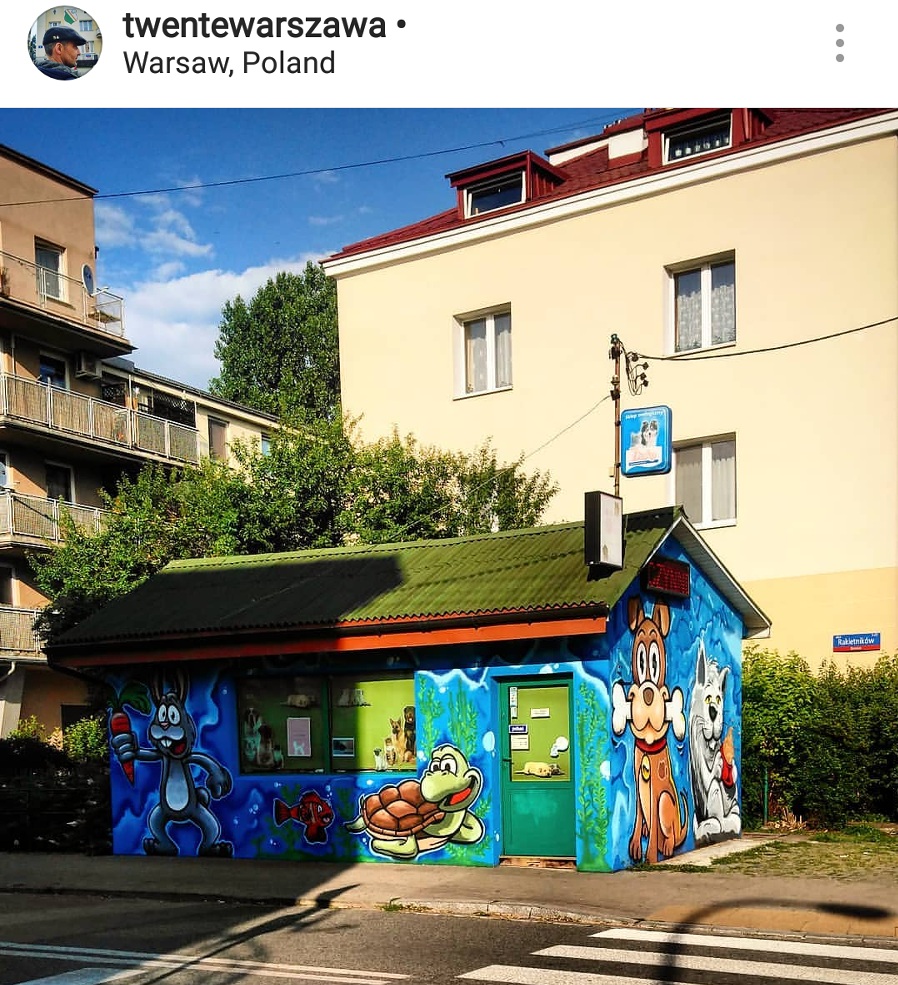
Also our local pet shop around the corner got a slight make-over recently:


I made the below video when I was in the bus (Puławska street) with Mrs MyWarsawDream and mama Mrs MyWarsawDream. The wall is from a horse race track named tor wyścigów konnych Służewiec. Also here it is legal to place graffiti. So sit back, relax and enjoy (put your sound on).


Monday, 16 July 2018

Czesław Niemen

Czesław Niemen (February 16, 1939 – January 17, 2004), born Czesław Juliusz Wydrzycki, and often credited as just Niemen, was one of the most important and original Polish singer-songwriters and rock balladeers of the last quarter-century, singing mainly in Polish.


Niemen was born in Stare Wasiliszki in the Nowogródek Voivodeship of the Second Polish Republic (now in the Grodno Region of Belarus). Czesław Niemen belonged to a community of Poles, living outside the eastern borders of contemporary Poland, on the eastern lands of the historical Polish-Lithuanian Commonwealth (called 'Kresy' - 'borderlands' - in Polish).  

In the dawn of World War II these ethnic Belarusian lands were annexed by the Soviet Union and became a part of Belorussian SSR, according to Europe's post-war reorganization performed during the Yalta Conference.
 
1960s
He made his debut in the early 1960s, singing Polish rock and soul music. He possessed an unusually wide voice range and equally rich intonation. He was also an ardent composer and a keyboard player.  

In 1964 at Congress Hall, Warsaw, Niemen, together with his group, played as a support act to Marlene Dietrich during her concert. She heard his song "Czy mnie jeszcze pamiętasz" ("Do you still remember me?") there. She enjoyed it so much that she soon recorded her own version of it "Mutter, Hast du Mir Vergeben" ("Mother, have you forgiven me?") writing her own lyrics for the song.


Soon after his first successful concerts in France, he started to use the pseudonym Niemen instead of his real name, gaining wider notoriety in Poland and making it easier to pronounce by foreigners (Niemen is a Polish pronunciation of the Neman River, which flows in close proximity to his place of birth). His song of 1967, "Dziwny jest ten świat" (Strange Is This World) is commonly acknowledged to be the most important Polish protest song of that era (in 1972 an English version was also recorded). The song was influenced by the American blues tradition. He was one of the first Polish performers to wear long hair and colourful clothes and introduced the style of psychedelia to communist Poland, which annoyed the officials.  

The first three LP album's Niemen recorded with his band "Akwarele" (Watercolours). Subsequently, he recorded with his other new bands: "Enigmatic", "Grupa Niemen" and "Aerolit". In 1969 he changed musical style to progressive rock while recording the monumental album Enigmatic. The most notable song from it was "Bema pamięci żałobny rapsod" (A Mournful Rhapsody in Memory of Józef Bem), based on the 19th century poem by Cyprian Kamil Norwid. The rest of Enigmatic songs were also in sung poetry form. Niemen played Hammond organ, later mellotron and Moog synthesizer on his records.


1970s
In the early 1970s, Niemen recorded three English language albums under the CBS label, two of them (and three more in Poland) with the Silesian band SBB. With SBB Niemen performed at the Rock & Jazz Now! opening show for the 1972 Summer Olympics in Munich sharing the stage with Mahavishnu Orchestra, John McLaughlin and Charles Mingus and subsequently toured with the band of Jack Bruce. In 1972 he also contributed with a song performed by him in Wesele (The Wedding) by director Andrzej Wajda, laureate of an honorary Oscar. In 1974 he recorded Mourner's Rhapsody with Jan Hammer and Rick Laird from Mahavishnu Orchestra. In the seventies, Niemen turned to jazz-rock fusion and electronic music (Katharsis album).  

Later years and death
Niemen went on to compose film soundtracks and theater music, and in the 1990s he showed interest in art, painting and computer graphics.  
He died of cancer on January 17, 2004 in Warsaw. His remains were cremated and placed in a columbarium niche on Powązki Cemetery in Warsaw on January 30, 2004. 
 

Legia Warsaw

Nowadays you still hear his songs on the radio, these still get airtime. Next to this one of his most famous songs is about Warsaw, 'Sen o Warszawie' is the title. It means 'dreaming of Warsaw' and is the anthem of football club Legia Warszawa. Every home game this songs is blasting through the speakers and all fans are belching out its lyrics, really nice. 

A nice end of this week's blog post...


Source: Wikipedia


Statistics

Just some statistic I posted a couple of months ago: Pretty amazing isn't it? Lets go over some other ones, not necessa...