Monday, 10 December 2018

PEWEX


Pewex (short for Przedsiębiorstwo Eksportu Wewnętrznego - Internal Export Company) was a chain of hard currency shops in the People's Republic of Poland. They sold otherwise unobtainable Western goods in exchange for Western currencies, most commonly the US dollar.

Pewex pouch where people could keep their USD

The odd thing is that the possession of Dollars was not allowed during the communist era. However, Poles always find a way. These were traded on the black market like cigarettes are nowadays.

History
By the late 1960s, it had become apparent that the then socialist centrally-planned economy of Poland was inefficient. The rule of Edward Gierek led to a short period of economic prosperity. With the aid of foreign loans, Gierek instituted a programme to modernise industry and increase the availability of consumer goods. The standard of living increased markedly and for a time he was hailed a miracle-worker. The economy, however, began to falter during the 1973 oil crisis and by 1976 price increases became necessary, mostly to ease the repayment of these loans.

Foreign currency
In order to obtain much needed foreign currency from Polish society, authorities permitted in 1972 the creation of a network of shops under a state-owned bank named Pekao. There, the foreign hard currency could be exchanged for both foreign and domestic goods, many of which were unavailable to Poles at that time. Since ownership of hard currency as cash was forbidden and all dollars and Deutschmarks had to be deposited to dollar bank accounts, authorities introduced Bon PeKaO cheques, which were tied to the U.S. Dollar in a 1:1 ratio and could be used as currency in Pekao shops.
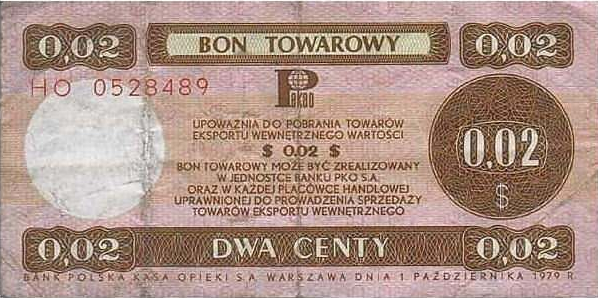

Later on the Pekao bank created a separate company, Przedsiębiorstwo Eksportu Wewnętrznego - the Pewex. While the letter x is not present in the Polish alphabet, it was used nevertheless, so that the name would sound somehow exotic and Western-like in the ears of the mostly pro-American society.


For years, the Pewex shops were the most common way for people in Poland to purchase unavailable consumer products. Pewex offered a large variety of products unavailable otherwise to the Polish population. These included jeans, Coca-Cola, alcohol, sweets, toys, cigarettes, electronics, and colour TV sets.


In addition, Pewex offered a number of Polish-made products that were otherwise intended for export only, including vodka and Krakus ham (hence the name "internal export"). Moreover, the Pewex chain was very popular among foreign tourists and diplomats, who could buy Western articles at very reasonable prices (sometimes even as low as 40% of their cost in the West) and tax free.


During the 1980s' economic crisis, when the state-owned shops for ordinary people offered barely anything, the Pewex shops were sometimes the only places where one could buy basic foodstuffs and other basic articles like toilet paper. Finally, in the 1980s, Pewex shops became one of the very few places in Poland where cars and flats could be bought without having to wait for several years.


As part of the peaceful transition of the economic system in Poland after 1989's revolution in Poland, the Polish economy was privatised and the ownership of foreign currency was deregulated. This made the Pekao cheques obsolete and soon afterwards most of the goods that had only been available from Pewex stores started to be sold in private shops as well. In the mid-1990s, the chain was heavily mismanaged, eventually privatised but soon afterwards went bankrupt. The destruction of the Pewex brand, one of the most recognizable in the People's Republic of Poland, is considered a good example of brand mismanagement.

But anyway, a fine piece of Polish cult!

Take care folks, cheerio.


Source: Wikipedia 


Saturday, 8 December 2018

Janusz Korczak


I made this photo somewhere in the year 2017 and did not pay real attention to the statue to be honest. Just a while ago I noticed it was a man holding children in his arms. The man, Janusz Korczak, is a war hero. Not an army General or Marshall, but a normal civilian with a great heart. Let me tell you a bit more about him. 

Janusz Korczak 
1878 - 1942

Physician, pedagogue, writer, journalist and social activist. Born as Henryk Goldszmit  in Warsaw, died in Treblinka. 

Janusz Korczak was born into the polonised Goldszmit family - his great-grandfather was a glazier, his grandfather was a doctor and his father, Józef Goldszmit, was a well-regarded Warsaw attorney. He himself, as both a Jew and a Pole, felt that he had two nationalities.

In March 1905 Henryk Goldszmit obtained his PhD and began working at the Jewish Berson and Bauman Hospital for Children in Śliska 51 street in Warsaw. As the resident doctor, he was obliged to provide 24-hour care to the ill and medical advice in the hospital's infirmary (regardless of faith); apart from that he also acted as a home-visiting doctor. Korczak was drafted to the Russian-Japanese war and in the years 1905-1906 gained experience as a military doctor.

Orphans Society
In 1912 he once and for all gave up work at the hospital and took up the post of director of the newly-opened Jewish House of Orphans, which operated under the patronage of the Help to the Orphans Society. There he collaborated with Stefania Wilczyńska, who helped him implement his authorial pedagogical concepts and creatively contributed to the development of the establishment. The House of Orphans became for Korczak a place of daily detailed observation of the psychophysical development of a child. There, innovative paedagogical ideas were conceived, such as that of the children's parliament, court, newspaper and notary. 


During the first days of the II World War, together with fellow tutors and co-workers he was present at the House of Orphans day and night. In September 1939 he spoke for the last time on Polish Radio, appealing to the people to remain calm. From the very beginning he constantly tried to obtain support for his institution. In the summer of 1940 he managed to organize summer camp for the children at a branch of the House of Orphans in the Wawer district of Warsaw. In the autumn of 1940 the House of Orphans - as a Jewish institution - was relocated to the ghetto to Chłodna 33 street, to the building of the Maria and Józef Roesler Secondary Trade School and Korczak was arrested for a brief period for not wearing an armband with the Star of David, which the Nazis ordered every Jew to wear.


In October 1941 the House of Orphans was once again forced to relocate. Korczak fought constantly for financial resources to pay for the maintenance of the children, but above all he made efforts so that, despite of the hopeless situation, life in the House of Orphans would run according to the prewar rhythm. As much as possible the old ways of functioning and internal habits were preserved. In the beginning of 1942 Korczak officially took up supervision of the shelter for orphans Main House of Shelter in Dzielna 39 street, which was in terrible condition. In May 1942 he began writing a diary which described the dreadful reality of the Nazi occupation.

Korczak consciously turned down opportunities which could have saved his own life: he didn't accept help to leave the ghetto and going into hiding, which was offered to him by his friends and on deportation day, in the morning of the 5th of August 1942, during the Grossaktion (the main stage of exterminating the population of the Warsaw ghetto) - he refused abandoning the children and workers of the House of Orphans. 


The last march taken up by Korczak and the children to Umschlagplatz is legendary, certified by many accounts and memories (not always coherent and credible in detail). It lived and continues to live its own life - in a mythologised version. However the essence of this legend reflects the real truth about Korczak - that he was a solid moral authority for all those who looked up to him for guidance and hope.

Source: culture.pl

Sunday, 28 October 2018

The Varso tower

The tallest and most prominent building in Warsaw is the Palace of Culture and Science. Around the 237 meters tall communist building have been popping up skyscrapers in record tempo. In a few years even more will be finalized, it just does not stop.

One of the building sites we regularly pass when driving to city center. There workers are busy completing a very ambitious project of a new skyscraper, Varso Tower. With a stunning 310 meters a new record will be set once completed.


Varso Tower
Nearly 10,000 cubic meters of concrete and 2.5 thousand tons of reinforcement will be used to solidify the Varso Tower, the highest office building in the European Union. Together with the mast, it will be 310 meters high. The foundation slab is being built on the site of the future complex next to the Central Railway Station in Warsaw.


The Varso complex (the name comes from the Latin name of the capital - Varsovia) is created at the intersection of Al. Jana Pawła II and ul. Chmielna, next to the Central Railway Station in Warsaw. There will be a total of three buildings with heights of 81, 90 and 230 meters. The latter, named Varso Tower, together with an 80-meter mast, will measure a total of 310 meters, making it the highest building in the European Union. It will even dethrone The Shard in London, which is 309,6 m high and it is currently the highest facility in the EU.

The construction of the Varso Tower and the rest of the complex started officially in 2016 and this is how it will look like once completed:


There will be one of the highest viewing terraces in Europe (twice higher than the one in Pkin, the Palace of Culture and Science). In addition, it is to be available to everyone, both during the day and at night. On the 46th and 47th floor of the building there will also be a restaurant with a beautiful view of the capital.


The Varso complex is not just a "tower" itself. In addition, it will be created by two smaller buildings, 81 and 90 meters high. They were designed by the Polish architectural studio Hermanowicz Rewski Architekci. On their lively lowest floors there will be more restaurants and cafes, as well as small shops and service outlets, such as a pharmacy, laundry, drugstore, florist, newsagent or post office. In addition, public passages under the roof will serve Varsovians throughout the year.


All-in-all a very exciting project, I cannot wait to pay a visit to the viewing terrace!


Photos: HB Reavis
Source: onet.pl

Wednesday, 24 October 2018

The 1st of November (All Saints)

Today is All Saints day ('Wszystkich Świętych), a bank holiday here.

What I remember from my first experience were tons of flowers and even more colorful lights on graves. I made some photos back then, which I will show you here.


 All Saints’ Day is a Polish Catholic tradition where Poles from all over the country travel to their home cities to visit the graves of their deceased relatives and loved ones.
I knew the day in the Netherlands as well, but it is not a bank holiday there and it comes nowhere near the things taking place in Poland.


It is also quite common to hear people refer to this day as 'Dzień Zmarłych' or 'Święto Zmarłych' (Day of the Dead) – names that had been adopted during the socialism period in Poland as they did not contain any reference to religion.


So, in general All Saints is celebrated by the Catholics, plus some Protestants and in Eastern Orthodox churches. It dates back to the early fourth century.

All Saints’ Day is taken very seriously in Poland. No matter the weather conditions are like, you will see many people go to the cemeteries even a few days before cleaning up the graves.


Today, after the visiting the cemetery, people will usually get together with their families to have a meal and spend time together.

This is how it looks from above:


One of our friends once flew to Warsaw on the 1st of November. It was evening and he explained how magical this looked while descending to land on Chopin Airport. The city was just lit by all the candles on the cemeteries.

A very special tradition!

Zebra crossings in Warsaw

Zebra crossings, in the Netherlands I learned to always stop for pedestrians who want to cross the road. The only exclusion to the rule I made was when people were visibly doubting and not clearly on the verge of crossing the road. Make up your mind and I will stop I always thought.

I was brought up close to the German border. My parents learned me to stop for anything even close to the zebra crossing. Germans are ultra polite when it comes to stopping for zebra crossings, I also found out as a pedestrian myself when walking on the German streets.

Now Poland, or in my case my experiences in Warsaw. I found out quickly after arriving in this city that a pedestrian should be highly alert when crossing the road. I can remember a couple of close calls, looking into a pair of headlights like Bambi.


I thought it were just a couple of jerks, but later found out that the average driver barely stops for pedestrians wanting to cross the road. It depends a bit of the area though, close to our home the chance is a bit higher that a car will stop at zebra crossings without traffic lights.


This was raising questions to me. Are the rules different here? Are people just less polite in traffic?

At a first glance, the answer to that is pretty simple I found out. Germany and the Netherlands have similar traffic laws concerning zebra crossings. Poland has different rules, way different.


In Poland pedestrians at zebra crossings do not have priority to vehicles driving the road!

The pedestrian only has this priority when already walking on the zebra crossing. And you can only start crossing the road when no cars are nearby. This in combination with a friendly driver who clearly shows behavior of letting the pedestrian cross.

This raised more questions to me because every single person interprets the term 'nearby' differently. The opposition parties in Poland are already fighting for a change of this law since three years, but one of the bigger opposition parties voted against it a few years ago and the proposal was declined with one vote difference.


The opposition party in question is now the leading party by the way (PiS). To make the matter even more confusing, they are working on dusting off the proposal and make this change in the near future...

Clearly a fine. And time for traffic lights there. 

So the verdict is: just be careful out there.


Tuesday, 23 October 2018

Rondo Tybetu

The Tibetan Gallery at the Tibet Roundabout in the Wola district of Warsaw is a fine example of what a little bit of colour can do to an otherwise dull urban area.


Started in 2009, following the Dalai Lama's visit to Warsaw, street art depicting the Tibetan struggle for autonomy from Beijing was painted here on the pillars of a flyover (the Chinese government didn't quite like the idea!).


The initiative coincided with Warsaw City Council's decision to award the Dalai Lama honorary citizenship of the city! Along with various pieces of art depicting the Tibetan struggle, there is a commemorative plaque dedicated to the heroes of the Tibetan national uprising of 1959.


I passed this place a couple of times when I took the bus, but never saw more than just a quick glimpse. It is not far from my work, so I went to have a proper look at it after work. 


A stunning place it is. More than a hundred works of street art in one place.


With many pillars still left to fill, it's likely this artistic oasis will continue to grow and inspire. Above all, the Tibetan Gallery is a reminder that we are responsible not only for what we do in our home country, but that we have the power to create a dialogue with the whole world.

Let that sink in. Good evening :)

Tuesday, 9 October 2018

Hammer time

That it is pretty normal in German speaking countries to hammer the f*ck out of their 'schnitzels" was known to me. They like their pork shaped like a friggin' doormat don't they?

It did not take very long for me to find out that Poles also smash theirs like their lives depend on it. Their version, "kotlet schabowy" is part of the classic Polish kitchen.

If you live in an apartment, you should not be surprised to wake up from a hammering sound on a Sunday morning. It is not an SOS signal using Morse code, but it will be one of neighbours in the block battering their "schab".


The huge ones they do call 'sznycel', which obviously derives from the 'schnitzel' being popular in German speaking countries and also in the Netherlands. Although I do believe that it is not the same meat, but who gives a toss 😋

Sznycel in Warsaw's Old Town

It seems to be the same principle as making a veal schnitzel, but then with a double slice of pork meat, delicately cut until the end is almost reached. And then...Hammer Time 😎

Let me show you... turn on volume. Recorded in Polish, inclusive of white socks in fake leather sliders. Integration is hard work, but a man"s got to do what a man's got to do.


Later folks! 

Statistics

Just some statistic I posted a couple of months ago: Pretty amazing isn't it? Lets go over some other ones, not necessa...