Friday, 13 July 2018

Pomnik Kościuszkowców

It might not look so huge on the photos I took, but it is huge. 18 meters high, "Pomnik Kościuszkowców" it is called, monument to the Kościuszkowcy. Or Kościuszko Infantry Division Memorial.

Kościuszkowców, try to pronounce it 😉


Now check the below photo with our friend included :) Pretty impressive when standing there in real I can tell you.


This memorial commemorates the attempt by the Polish 1st Division "Tadeusza Kosciuszki" to give aid to the Warsaw insurgents. Kościuszki was a national hero living a long time before, they named this division after him. 

In September 1944, catastrophic landings took place on the west bank of the Vistula river with the result of more than two thousand dead, missing and wounded on the side of the liberators. There was no chance and is a black page in Polish history. The lack of support from the Red Army, who were sitting out and anticipating the fall of the uprising, the attempt was doomed to fail. Some call it courage, some stupidity, but I do not have an opinion about it. 

 
Thanks to its overall appearance, the statue is being nicknamed 'Batman'. 

I really like to be in this part of Warsaw, the Praga district on the other side of the Wisła river from our perspective. Soon I will publish a post about a day out with 4 of our friends, photographers from Warsaw. We walked through the district the whole day and made some great photos. 

Take care folks, see you around. 

Thursday, 12 July 2018

Krasnoludek

"Krasnoludek" - dwarf in Polish. You see many of these Krasnoludki in the streets of Warsaw. If you pay attention to it you will see so many of them, it is insane. 

Let me show you some photos I took, showing this dwarf sprayed on the ground or stickered elsewhere. Especially during the last few months, the stickers are placed all across the city.

Śródmieście district

 
City center

Now the million dollar question: who or what is this? 
It is "Krasnoludek Chodnikowy", a bit odd to translate but "Dwarf on/of the pavement" would do here. That explains why most of them are sprayed on the ground using a stencil template. 


Instagram account of Krasnoludek Chodnikowy
 
But why? Just for fun? 
I would say partially. There is a statement behind them. It is a sign of the so called "Orange Alternative".

Orange alternative
The Orange Alternative (Polish: Pomarańczowa Alternatywa) is a Polish anti-communist underground movement, started in Wrocław, a city in south-west Poland and led by Waldemar Fydrych, commonly known as Major in the 1980s. Its main purpose was to offer a wider group of citizens an alternative way of opposition against the authoritarian regime by means of a peaceful protest that used absurd and nonsensical elements.

By doing this, members of the Orange Alternative could not be arrested by the police for opposition to the regime without the authorities becoming a laughing stock. The Orange Alternative has been viewed as part of the broader Solidarity movement.

Initially it painted ridiculous graffiti of dwarfs on paint spots covering up anti-government slogans on city walls. Afterwards, beginning with 1985 through 1990, it organized a series of more than sixty happenings in several Polish cities, including Wrocław, Warsaw, Łódź, Lublin, and Tomaszów Mazowiecki.

It was the most picturesque element of Polish opposition to Stalinist authoritarianism. It suspended activity in 1989, but reactivated in 2001 and has been active on a small scale ever since. A statue of a dwarf, dedicated to the memory of the movement, stands today on Świdnicka Street in Wrocław, in the place where events took place.

Dwarfs -krasnoludki- in Warsaw
They appear everywhere, however, the most can be found in the district Ursynów. They left the Kabacki Forest and set off into the city. Many people first thought that they are advertisements.
But all it promotes is some positive energy, kids like them and it is a funny and colorful sight.


Śródmieście district

These sprayed dwarfs appeared in Warsaw in 2010. Piotr Ginalski, 'father' of many of the dwarfs, What is it all about? This is what mr Ginalski answered when he was asked:

Why dwarfs?
"Because dwarfs are cool! In my childhood, in the 1980s, I heard the legends about the Orange Alternative, later I met Gamon and the Dwarves (spelled like Tolkien spells the word). There the idea of painting dwarfs on the city streets was born."


Mokotów district

"Major Fydrych, with whom I was doing happenings in 2006 and 2010, appeared at the vernissage of the exhibition in Hoża. We met there after a few years break. But now, I do things my own way, although I do not cut myself off from the past."

Dwarfs can be found throughout Warsaw, in Lodz. Is the choice of their place random?
"Yes and no. Dwarfs emerge from the Kabacki Forest and are found on the routes that I usually move. They are also where I live, meaning Ursynów. But there are places where they are not accidental. They guard, for example, Plac Wielki Przygody - it is a pity that they have to do this instead of officials who do not want to protect this green space."

How do people react when they see the birth of a dwarf?
"Definitely positive. Ladies in the grocery store always smile warmly, in the paper shop I already have a discount on cardboard, which I use to make templates. Parents with children often ask for a dwarf, but there are also interesting situations ...
An elderly lady in Mokotów, she said that Stańczyk, whom I painted on the sidewalk as a horned devil! Another time, someone passing by called the police suspecting me of painting anti-government slogans. They were very surprised when they saw that I was painting dwarfs."


What is the police doing in such a situation? Are they arresting a dwarf?
"Yes - one of them at Dzielna street. We are planning to take it off from there. It was funny when I rang to ask if I can pick him up again because I'm organizing an exhibition for the Capital City of Warsaw. It turned out that he was evidence in the case and could spend up to three years in prison."

"An interesting situation also took place under the PiS headquarters (leading government party in Poland), where I painted patriotic white and red dwarfs. Security took my portfolio with the templates. The next day, all of them were painted blue."


Ochota district

People often think that dwarfs are advertising. But for what?
"Once I heard that it was an "Intermarche" (French retail chain) advertising, so I started to practice painting red dwarfs with black dots (like Biedronka's logo, another supermarket chain names after a ladybug).


Do the dwarfs have any specific plans for the future?
"For now, they are going to defend Placu Wielkiej Przygody (green area in Warsaw). The Ursynów district started following the profile of krasnoludki on Instagram, I would prefer that it start to observe the movements of developers around the square and the mood of the residents who want to protect the greenery in their neighborhood."

"And besides, I hope to cooperate with one of the Ursynów community centers. I see that children are very interested in dwarfs. I often give them photocopies of the characters, together we draw faces and color them with markers. I would like to do workshops for these kids."


What a nice guy :)
Take care folks!

Wednesday, 4 July 2018

Polish superstitions (4-6)

A while ago I wrote about Polish superstitions. Three were handled, but there are more.

Many more. This week I will write about another three. Starting with dwarfs.


Can’t find something? Ask the dwarfs
This method applies to all things lost at home. Just step out of the room where the lost item should be, close the door behind you, and then loudly tell the dwarfs: ‘Play and put away’. You will not see those little friends, but they are there.


The missing item will then show up. I tried myself, with mixed results.

Where there’s a squirrel, there’s smoke
Another superstition says that a squirrel on a roof is a sign of fire closeby. So if you notice one of those little creatures on top of your house, don’t hesitate: call the fire department.


I did not see any on roofs so far. There are tons of them in the city, in the various parks. A while ago we were sitting at a bus stop and mister squirrel did not bother and just sat next to us :-)


A chimney sweep, a priest & a white horse
Encountering a chimney sweep is said to bring good luck in many cultures, don't ask me why. In Poland, however, for the superstition to work you need them to ‘confirm’ the good luck by grabbing one of your buttons. Another variation of this belief which is super-Polish: There’s nothing better than seeing a chimney sweep, a priest and a white horse in a row. That combination is the best omen of them all.

This one will make Polish people laugh I bet. I have this feeling that no-one has ever heard of it and my source was taking the piss outta me :)

Thanks for reading folks, cheerio

Free bicycle repairs


For cyclists the city of Warsaw offers a free service for two-wheelers, available in the Summer Recreation zone on Poniatowski Bridge beach between the 23rd of June and the 26th of August. Inhabitants of Warsaw will not only do a technical inspection, but also do basic repairs and adjustments. Service technicians will help in repairs and inspections of bicycles free of charge.


If a problem cannot be sorted on the spot, they will provide further advice. During the hours 10:00h - 18:00h chain wear and bearings checks can be done, as well as brake and suspension adjustments and cleaning of vital parts. You can even have your inner tube replaced in case of a flat tyre.


Next to this the city has installed small unmanned service points for riders to perform fixes to bikes.
See below map: the blue and green circles are places where people can rent a bike. I blogged about these before, Click here

The black icons are the small unmanned stations.


I made a picture of one of these so you can get an idea how this would look like:


This is one at Marszalkowska Street. I guess they put the orange cone next to it after someone broke his neck because of it. I can imagine it is pretty tough to pass it after a heavy night out.


There are tons of these stations across the city by now. This and the free bike repairs, affordable bike renting and investment in the city infrastructure for bikers makes me conclude that the city takes it seriously. 

Which is super. 


Tuesday, 3 July 2018

Polish customs: Wedding games and more

If you ever happen to be at a Polish wedding party and you hear the word 'oczepiny': run and hide!

Oczepiny is a common Slavic tradition which symbolises the transition of the bride from maiden to married woman. Traditionally the bride had her hair cut or shortened and a cap put on. This is also where the name comes from, as czepiec is Polish for 'cap'.
 
The most insane wedding games are organised. It usually starts with the throwing and catching of the bride’s bouquet, still pretty normal. After that anything can happen. You may be asked to pass an orange to the aunt you don’t know. Without using your hands...through your pants...

Or that same aunt needs to pop a balloon which is on your lap, without using her hands.
Check the video to get an idea how that would be.


You could also be asked to change your gender for a while and dance the rumba or the tango with a person of the same sex, you could be asked to down far too much wódka in a very short time, or even worse. As a foreigner you are pretty much f****d, because most Poles can handle a lot of alcohol.

Second wedding party
This is called 'poprawiny'. In a nutshell it is a continuation of a wedding party the day after the main event. The continuation can last several days, I know a couple who partied 5 days in a row, but mostly it is one day. I experienced it and had breakfast with people who went all the way the night before, just a few hours later.

Our wedding
So, our wedding. How did it go? Well...none of the above. Apart from that it was typical Polish with lots of food and drinks, singing and dancing. I forgot to mention that Polish weddings last longer than in the Netherlands, where most wedding parties would end around midnight or a little later.
People who know me good know that I am not really a party animal, I would prefer a calm and relaxed dinner over a loud party. But I have to say I really enjoyed it, with my Bavaria 0.0%. Yes, me...singing and dancing. I have many witnesses and a lot of material caught on film. Which I obviously will not show.


Take care troopers

Monday, 2 July 2018

The Warsaw Ghetto

Some time ago my wife came up with the idea to go for a walk in and around the center. She found a route online where you can walk around the Warsaw Ghetto (where the walls used to stand during the second world war).


I had seen these so called 'markers' before, but never realized that these were part of a route.


The Warsaw Ghetto boundary markers are memorial plaques and boundary lines that mark the maximum perimeter of the former ghetto established by the Germans in 1940 in occupied Warsaw. The markers were erected in 2008 and 2010 on 22 sites along the borders of the Jewish quarter, where from 1940-1943 stood the gates to the ghetto, wooden footbridges over Aryan streets, and the buildings important to the ghetto inmates.


The Warsaw Ghetto
The Warsaw Ghetto ("getto warszawskie") was the largest of all the Jewish ghettos in German-occupied Europe during World War II. It was established by the German authorities in the Muranów neighborhood of the Polish capital between October and November 16, 1940; within the new General Government territory of German-occupied Poland. There were over 400,000 Jews imprisoned there, at an area of 3.4 km2, with an average of 9.2 persons per room, barely subsisting on meager food rations. From the Warsaw Ghetto, Jews were deported to Nazi camps and mass-killing centers. In the summer of 1942 at least 254,000 Ghetto residents were sent to the Treblinka extermination camp during "Großaktion Warschau" under the guise of "resettlement in the East" over the course of the summer.


The death toll among the Jewish inhabitants of the Ghetto is estimated to be at least 300,000 killed by bullet or gas, combined with 92,000 victims of rampant hunger and hunger-related diseases, the Warsaw Ghetto Uprising, and the casualties of the final destruction of the Ghetto.

The walk
While walking the route, I learned that there was not one big ghetto. The ghetto was growing; a smaller ghetto was being connected to the bigger ghetto by the footbridge I mentioned earlier.


The shadow you see over the line marking the ghetto wall is the shadow of the marker of the bridge. 


I can remember I got this strange feeling when walking there, felt chills over my spine. Remains of the ghetto are very limited, as this area was bombed to the ground.


Below you can see some remains of the ghetto wall. This place was close to the wooden bridge, connecting the big ghetto with the small ghetto.


Besides the official markers and plaques, there are several places where you can see the shape of the ghetto and a text sprayed onto the wall.


Polish and Hebrew for "here was the ghetto."

Earlier that year 
I spoke to an older man once during one of my walks after Polish classes, he was born right before the war he told me. My Polish was very limited, but the man spoke in a very calm and fascinating way. It was exactly here:


It was in ulica Waliców where we met, also former Warsaw ghetto. What you see is the zabytek (monument) of Waliców 14.

I told then man that I was fascinated by Polish history, especially the 2nd world war and post war era. There has been some controversy about the subject of the uprising in the Warsaw ghetto lately, Israeli journalists were poking up a fire around this subject. Therefore I always am very cautious when talking about it, choosing my words carefully. Same counts for the communism era by the way, the limited history lessons I followed covered just a very general description.

But we walked along and kept talking.


The old man also spoke slow and with care, he was a very wise man. He told me that he will never forget this time, but that we now live in 2018 and the world has changed. We should make the best of it now and not look back too much. You can understand that this was pretty impressing for me as I understood his Polish, but could not really respond to him in a way I wanted.


He felt it and changed the subject to my brand new fast "trampki" (slang for sports shoes). This man also used slang words, so nice. We walked along for a while talking about Poland and Warsaw, it was really nice.

The most bizarre was that we ended making jokes about being married to a Polish woman. Well, he made the jokes and I listened...


Mushroom picking

While most foreigners would never dream of risking a possible lethal case of poisoning by eating something they found in a forest, mushroom picking is a Polish holiday craze. People love it, and because approximately 30% of Poland is covered with beautiful woodland it is one of the most common ways of spending free time outdoors. Poles are eager to wake up in the early morning to pick mushrooms before others, and they teach children the names of all the species of mushrooms as well as acquaint them with techniques of recognising if the mushroom is edible or lethally poisonous. Picking mushrooms is a serious thing in Poland and Polish mushroom dishes are usually world-class delights.

Poles take their mushroom picking very seriously.


Contents of the article
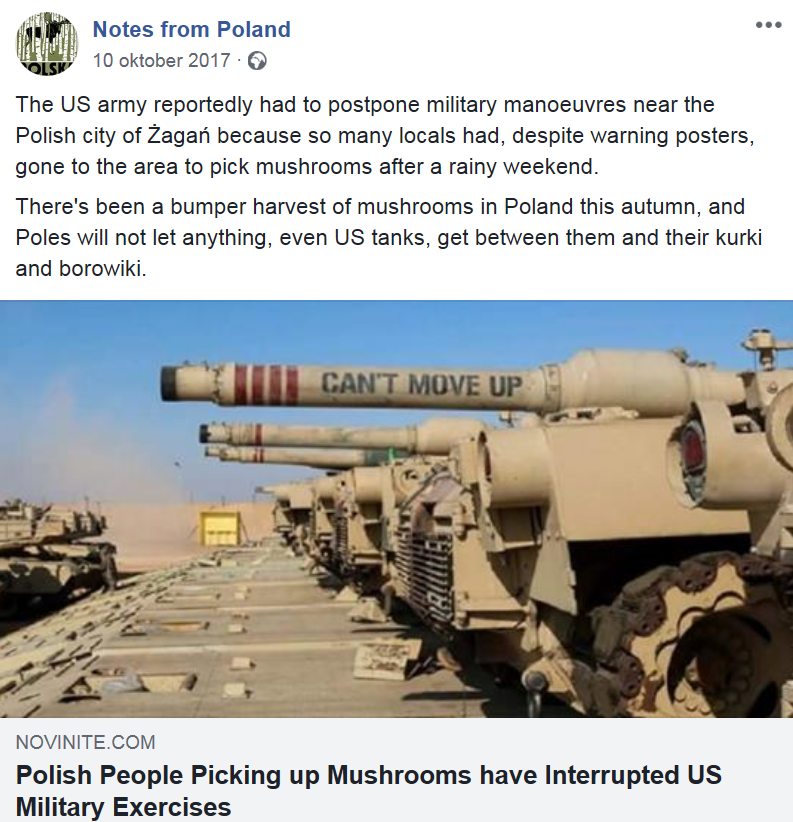
An invasion of Polish people picking up mushrooms ruined the teachings of an American tank unit near the western city of Jagan, RIA Novosti reported. US combat machines yesterday had to shoot in the area. The heavy rains during the weekend, however, caused an abundant mushroom crop, and many residents of the area set out to collect the plants. The people were not concerned by the warning posters in Polish and English, and the command was forced to cancel the maneuvers.
The Central European state hosts an exercise involving about 3,500 troops from the United States. America has increased its military presence in Central and Eastern Europe after Russia occupied the Ukrainian Black Sea coast of Crimea in 2014.
 
So what about mushrooms do Poles learn at a young age?
Every mushroom has a part under the cup called the hymenophore that’s either a lamella (striped) or tubes (flat). Mushrooms with tubes are edible and those with lamella can be. Or not ;-) If the mushroom is red with white dots: walk on, it is very poisonous.
 
When does this all take place?
Every September, families in Poland go mushroom picking together. After a successful search, mushrooms will be either dried or pickled, I guess you can imagine how these houses will smell...
 
What do people use them for?
Poles like to cook using mushrooms, let me mention a few dishes.
 
Placki ziemniaczane & kluski with mushroom sauce – Chanterelle / Porcini
Placki are potato pancakes that can be served with either goulash or mushroom sauce. The best sauce is a chanterelle (kurki) sauce, according to many.


Pierogi filled with mushrooms
Pierogi are well-known all over the world. Those amazing dumplings can be filled with pretty much anything, but the best combination according to many is cabbage with onion and porcini.


Pickled mushrooms
Very popular for Christmas, see the below picture.


All very tasty. Even in Warsaw I see people picking mushrooms in parks, I still remember the moment that I saw a woman of at least 80 years old climb a hill which was so damn steep that I would doubt to go up myself. It was not making any impression to my wife, with me asking her the famous question I would ask her many more times: "Is this normal in Poland"?

Thanks for reading, take care.

Statistics

Just some statistic I posted a couple of months ago: Pretty amazing isn't it? Lets go over some other ones, not necessa...